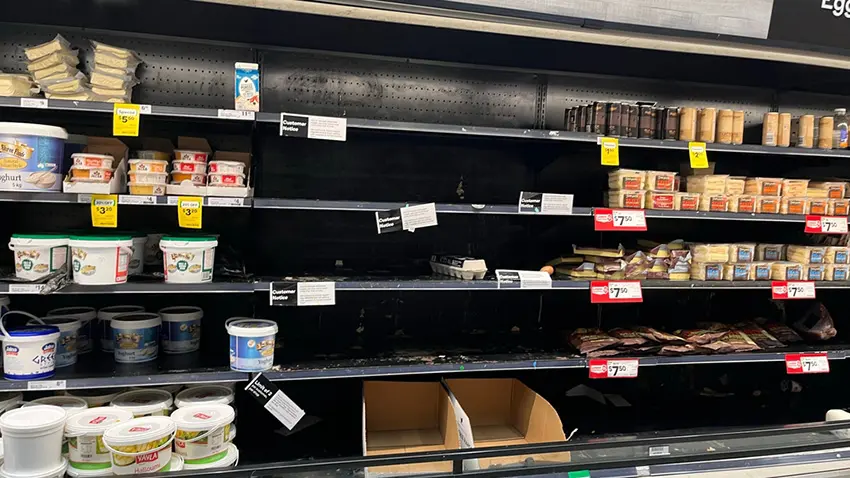
Britain’s supermarkets could be staring down the barrel of patchy shelves by midsummer, with ministers quietly war-gaming a scenario in which the continuing conflict with Iran chokes off carbon dioxide supplies to the country’s food and drink industry.
Whitehall officials have been rehearsing what they describe internally as a “reasonable worst-case scenario” should the strait of Hormuz remain closed into June, shipping routes stay jammed, and a mechanical hiccup at one of Britain’s critical CO2 plants compound the pressure. The exercise, codenamed Turnstone and convened under the Cobra emergency framework, has drawn in officials from Downing Street, the Treasury and the Ministry of Defence.
News of the drill, first surfaced by The Times, has prompted a rapid-fire reassurance campaign from ministers, who insist the planning is prudent rather than panicked. Business Secretary Peter Kyle told Times Radio on Thursday that the leak was “unhelpful” but argued the public “need to be reassured that we are doing this kind of planning”. CO2 supplies, he added, were “not a concern” for the UK economy.
For small and medium-sized food producers, brewers and hospitality operators, however, the contingency talk lands at an awkward moment. The summer trading window, already inflated by the World Cup kicking off on 11 June, is make-or-break territory for independent breweries and wholesalers. A squeeze on carbon dioxide would ripple rapidly through their supply chains, hitting everything from pint pulls to packaged meats.
Carbon dioxide, though a by-product of other industrial processes, is the quiet workhorse of British food and drink. The gas is used to stun pigs and poultry at abattoirs, to pack fresh meat and salad leaves in modified-atmosphere packaging that keeps bacteria at bay, and to put the fizz in beer and soft drinks. It also underpins refrigeration, MRI scanning, surgical procedures and the cooling of nuclear reactors.
The UK ranks among <a href="https://jordangazette.com/europe-faces-jet-fuel-crunch-as-gulf-supply-crisis-deepens/”>Europe’s heaviest consumers of the gas, a dependency that has already prompted pre-emptive action. In March, Mr Kyle earmarked £100m to restart the mothballed Ensus bioethanol plant on Teesside for a three-month run, specifically to hedge against wartime shortages. On Thursday he argued the Teesside decision showed “we are doing this kind of action behind the scenes to keep resilience in our economy”.
Britain’s largest grocer, for its part, appears sanguine. Tesco chief executive Ken Murphy said the government was “doing the right thing” in preparing for the worst, calling the analysis a reasonable one and welcoming the Ensus reopening. But he stressed Tesco had “seen nothing at this point” in its own supply chain and that none of its suppliers had flagged problems with CO2 availability.
Mr Murphy, whose business has absorbed six years of rolling disruption, Covid, Brexit, energy shocks, inflation, said Tesco was “constantly working on various scenarios internally” and confident it could head off issues before they reached the shop floor. The bigger near-term headache, he suggested, has actually been the punishing weather across southern Spain and north Africa, though shoppers would be hard-pressed to spot the fallout because the grocer had been able to “flex” its sourcing.
A government spokesperson underlined the caveat that “reasonable worst-case scenarios are a planning tool used by experts and are not a prediction of future events”, adding that ministers were “continuing to work closely with business groups to tackle the impacts of events in the Middle East”.
For SME owners watching the tea leaves, the message from Whitehall is calibrated: keep calm, carry on, but don’t mistake the silence on the shelves for complacency in the corridors of power. With Hormuz still contested and the diplomatic track with Tehran far from delivering a durable settlement, the summer trading season is shaping up as a stress test for a supply chain that, as 2021’s last major CO2 crunch demonstrated, can turn from background utility to front-page crisis within days.