
2027 Rivian R2 First Drive: For The Money, The Best EV So Far
Short of anywhere other than Marin County, Utah might just take the cake as the true home of Rivian. Towering snowy peaks resplendent in lush trees at lower elevations during late-Spring made for the perfect combination of city, highway, and off-road driving to test the all-new R2 model, and I spotted about a trillion of the R1S and R1T while cruising around the mountains. Presumably, when the R2 rolls out with a shockingly low price tag of just $44,490 to start, the hills will come alive with the silence of EVs.
The R2 truly targets the heart of the American car market, and not just for electrics but any potential buyer. Over the course of a one-day media drive, Rivian proved beyond a reasonable doubt that aspirational adventure design and engineering translates perfectly into an affordable EV. For either dedicated electric aficionados or first-time buyers, a solid option finally exists to tear market share away from the stalwart Tesla Model Y.
Real-world range, priced to sell
Deliveries begin this week for early R2 pre-orders, and four different trim levels will follow over the next year. The biggest number for any EV, the EPA range estimate, might not stand out as the R2’s main selling point, though. An 88-kilowatt-hour battery pack holds enough juice for a max of 345 miles on a charge, but only for the eventual single rear-motor Standard model that should arrive in early 2027.
The more powerful dual-motor all-wheel-drive Performance and Premium trims hit the market first, and cut that figure to 330 miles. The cheapest variant, the single-motor with an as-yet-unconfirmed smaller battery, will manage a Rivian-estimated “275-plus” miles eventually.
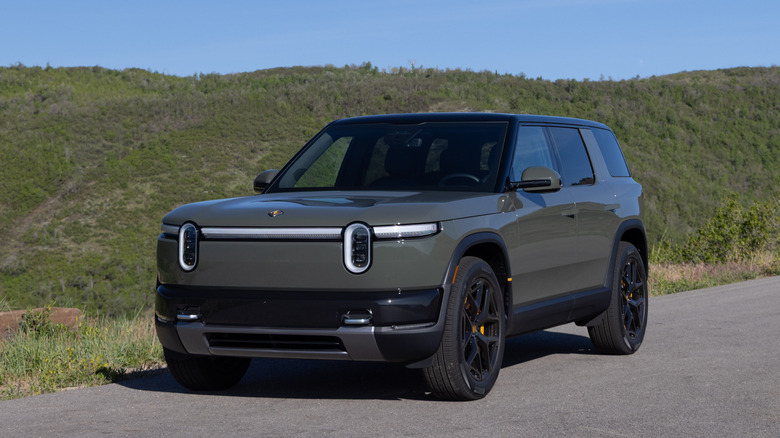
Those numbers might not jump off the page—or smartphone screen—but Rivian needed to tread a fine line between cost and range. Even the top-spec Performance R2 with the Launch Package still comes in at just under $60,000 and in reality, given the upright design, doing the miles per kWh math calculates to fairly impressive efficiency. Part of that comes courtesy of sneaky aerodynamics, from the front headlights that feed into smooth sides to the completely flat underbody, lower windshield rake, and roofline that flows back into a subtle rear spoiler matched by the angle of a rear diffuser below to reduce turbulence.
Familiar, but different
Overall, the shape and proportions carry over from the R1 models, though to my eye the R2 looked even smaller than expected. This form factor perfectly matches the most popular crossovers in America, but with a longer wheelbase that improves stability while driving and short overhangs that result in solid approach and departure angles. Without a third row, the R2 stretches the second row seating’s legroom significantly and the doors can fully roll down the windows to let nature in.
I never doubted the design, even if the R2 wound up even better in person. The bigger question in my mind as I flew to Salt Lake City surrounded whether Rivian might figure out how to fix everything I hated about the R1. Most importantly, the steering and suspension that felt chintzy compared to the premium materials and impressive powertrain. The R1’s combination of hydraulic roll control and air springs allowed for ride height adjustment during highway drives or for lifting the body up with impressive wheel travel while off-roading.
A ton of weight savings, literally
But air suspension usually rides smoother than smooth, and the R1 bounced and pranged about with a level of harshness that boggled my mind given the tall tire sidewalls. Clearly, the suspension prioritized on-road flatness to mimic normal commuter cars that weigh thousands of pounds less. And with overly light steering, the unfortunate combo struggled to live up to expectations—even if by the numbers, the R1 accomplished wild acceleration and fairly serious rock crawling despite managing much mass.
Because the R2 hauls around a little over half the battery pack of an R1S Quad, the ability to extract range out of the (technically 87.9) kilowatt-hours of lithium-ion improves. But more importantly, the driving dynamics take a massive step forward thanks to a curb weight of just 4,998 pounds for the dual-motor. Meanwhile, cost savings dictated ditching the hydraulic roll control in favor of more traditional sway bars. And a new steering setup replaces the R1’s ball-screw electro-hydraulic setup for a lighter dual-pinion design with an assist motor.
Falling in love with the R2
The improvement stood out immediately, and with more seat time I only fell more in love. Smooth and cushy with the shock dampers in the softest setting, when I felt the old urge to unleash all the electric torque in Sport mode, the suspension firmed up just the right amount to allow some lean, squat, and dive without any sense of ungainly imbalance.
Now, in fairness, the 656 horsepower and 609 lb-ft of torque that the dual-motor Performance package pumps out feels quick, if not overwhelming as on some other high-spec EVs. Rather than brutal launch control, the R2 punches hard and then continues pulling well past highway speeds. Enough to confirm that not a single crossover, ICE or hybrid, at this price point can hope to keep up.
Not quite hardcore yet perfectly capable off-road
Off-road, the R2 almost drives even better—at least, for an EV with independent suspension at all four wheels and a fixed ride height. One-pedal driving mimics hill descent control, which makes for a good time to mention the completely new brake-by-wire system that provides both firmer response to pedal travel but also an impressively calculated blending between the regen and friction brakes.
I barely even touched the brake pedal over the course of varying terrain, actually. For higher-speed sections in Rally mode—traction interventions turned down, of course—I let the regen liftoff dump the nose and start some rotation before hammering the go pedal and whipping around into full oversteer. Stepping between the modes quickly almost caught me out a few times, but if anything, this brief teaser only left me eager for more time on familiar territory to fully explore the R2’s capability.
Let’s get physical
The drive day also provided just enough time to appreciate Rivian’s improvements to UI, for the driver especially, without giving me quite the period necessary to fully adjust to all the new goodies. A fully overhauled OS 2.0 includes 200 tops of computing power just for the infotainment system, which now lives in a horizontally oriented touchscreen stretching across the R2’s dash.
Even more importantly, two new “Halo” dials on the steering wheel allow for physical control of the mirror and steering wheel adjustment, gauge cluster widgets, sound system volume, and climate control fan speed.
The dials worked fairly well all day, though the material and actuation feel slightly less solid than the rest of the R2’s familiar interior. Still, haptic feedback for frequent inputs makes a huge difference, especially since Rivian promises more software integration on the way in the form of an eventual AI assistant and full point-to-point autonomy to make short and long commutes a breeze.
Quality takes a big step forward
One thing I kept repeating both on-road and off, in another contrast to the R1, was the decided lack of clunks and rattles. NVH (noise, vibration, and harshness) always presents a challenge for electric automakers without an internal-combustion engine to mask any flaws. Every time I drove an R1, the creaks and buzzing from plastic trim made me think the whole body kept flexing under load from that stiff suspension.
The R2 improves mightily in that regard, and with the slick aero exterior, even lacks wind noise to cover up quality issues. I doubted that one single change of moving speakers off the doors and using a “force-bound” layout to create a noise cancellation effect alone accounts for the relative quietude—then again, maybe so.
In general, the R2’s packaging that splits the difference between a monocoque and skateboard layout helps impart the light and airy interior with plenty of spaciousness for both rows of seats, as well as a large trunk. A collapsible spare fits below the rear floor, though none of my three media testers actually came equipped with one. And Rivian reps chuckled a bit when I asked if a <a href="https://www.slashgear.com/1805536/subaru-pickup-trucks-history/” target=”_blank”>Subaru Baja-style R2T might ever hit the market. A bed that short makes less than no sense, anyway.
Build your dream Rivian
I do wish the drive allowed journalists a chance to drive the R2 back-to-back versus an R1S, if only to prove just how far Rivian came over the past few years. The refinements truly blew my mind, to say the least. My own R2 would probably be the lower-spec dual motor Premium with 450 horsepower and 537 lb-ft of torque—even if I might miss the additional grunt. I definitely need the roll-down rear glass that’s not available on the base model, and suspect I might want the semi-active shock dampers on the Performance trim, too.
A simple color scheme, probably Launch Green or a dark metallic grey (boring, I know) should help to hide some dirt. And obviously, I would buy the smallest 19-inch wheels and swap on some real knobbies. I tucked a hand in the wheel well and suspect a true 33-inch all-terrain tire will fit without needing a lift, though whether I stick with the BFGoodrich Trail-Terrains that come only on the 20-inch wheels or change over to a Yokohama Geolandar AT4 for the solid blend of performance and ruggedness might require some noodling.
2027 Rivian R2 verdict
I would prefer a solid roof rather than the standard panoramic glass ceiling, though, to keep the sun and glare out while better managing thermal insulation. And speaking of climate controls, the R2 seemed like the perfect opportunity to abandon the digital air vent control for true physical sliders to match the new Halo dials. A serious bummer. Slightly firmer steering in Sport mode might help a bit, too, since the R2 falls just short of the Porsche Macan EV or Lucid Gravity level of perfection.
Each of those premium electrics costs far more, though, and makes serious concessions of one kind or another. The Macan nails the sporty side of the equation, while sacrificing any semblance of off-road cred. And the Gravity drives stupendously well in any scenario, but looks nearer to a late-2000s minivan than a 1990s SUV.
In the end, I almost struggle to type out the statement, but for the money, the R2 might just be the only new vehicle I’ve ever enjoyed so much so quickly. Short of true supercars or the sublime 992.2 Porsche 911 GT3 Touring, anyhow. Rivian truly knocked this EV crossover out of the park, and I expect to see far, far more on the roads when I head to Utah for ski season this winter.